
Pour over coffee might be the best way to brew a perfect cup of coffee. Don’t be intimidated. It only takes a little investment, research, and time to learn how to make pour over coffee.
Coffee should be attainable. Coffee shouldn’t be fussy, elitist, or off-limits to certain social-economical classes.
But coffee culture can’t seem to help itself. Coffee has become almost as snooty as wine. Anyone can brew a killer cup of drip coffee, though.
I’m fortunate enough to have a husband that knows me well. He got me all the parts for a pour over set up for this past Christmas holiday. I told him I didn’t need a Chemex pour-over brewer. I did some research and found that the Bodum pour over maker is just as good and a bit cheaper.
I’ve been ordering pour over coffee (when I can find it) for years. It’s smooth, packed with caffeine, and one of the best cups of coffee you can get.
In this “pour over coffee explained” post, I want to talk about how pour over coffee came to be.
I also want this to be a “pour over coffee for beginners” post — explaining what you need to make pour over coffee at home.
Like most coffee drinks, this one can be a bit spendy when you order it at a coffee shop.
It’s also not a fast coffee that can be ordered (in most) drive through Starbucks; it’s a slower brewing method.
Let’s start with the history of pour over coffee.
Where Did Pour Over Coffee Come From?
People have been brewing ground coffee beans in hot water since the 15th century in Sufi culture. It’s so important that UNESCO has classified it as an Intangible Cultural Heritage.
For centuries, coffee was just ground coffee boiled in water and served as such. In the early 20th century, a German woman, Amalie Auguste Melitta Bentz, was tired of the grounds left behind in her percolator brewed coffee. She got to work on fixing her problem and is the founding mother of filter brewed coffee.
Amalie discovered if she punctured blotter paper with a nail, she could produce a coffee brewing method sans the grounds in the bottom of her cup. Her first prototype for this new coffee maker is the distant relative of the pour over coffee maker that the Third Wave Coffee movement has come to covet.
What Amalie and her husband, Hugo, ended up presenting at the 1909 Leipzig Trade Fair was a paper coffee filter. They would later on design the rudimentary version of the pour over. The paper filters and their brewing system were a hit and changed coffee forever.
The couple’s brewing system was a cone shaped filter basket that sat on top of a coffee cup or in their glass carafe. This would later be morphed into the Chemex — the coffee maker of choice by so many coffee lovers today.
We can all thank Amalie and her husband for bringing to market the first coffee filter and creating the Melitta Company. Melitta is the oldest coffee filter companies in the world and has been a groundbreaker in pour over since its inception in the early 1900s.
Equipment Needed for Pour Over Coffee
This method is one of my favorites, but it’s also one of the more expensive coffee brewing options. I don’t like how much brew gear is needed, but we are after the perfect cup of coffee, then so let’s do it.
I think coffee should be easy and unfussy.
But you just can’t make excellent pour over coffee without the following equipment:
4 essential pieces of brewing gear are required to make a cup (or pot) of pour over coffee:
- A kitchen scale
- A gooseneck kettle
- A pour over coffee brewer
- A burr coffee grinder
Just like any other hobby, your equipment requires some upfront investment.
I’m going to share with you my pour over coffee set up. It’s not the most expensive, but it did cost me about $150.00. I had some of the items in my kitchen already, and I bought the rest over time.
If you make 200 pots ( 1 pot a day for 2/3 of the year) then you’re looking at 75 cents a brew before you’ve earned your money back.
If you go to a coffee shop to get a pour over you’re going to have to wait for them to brew it for you (time is priceless). And it’s going to cost you at least $4.00 plus tip every time.
Pour over coffee is like a craft. And crafts cost money.
Bodum Pour Over Coffee Maker
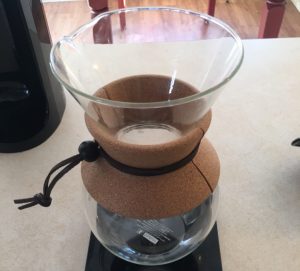 I chose this pour over maker because it was less expensive than the Chemex brand one. It does a fantastic job and didn’t hurt my wallet too much.
I think the draw to pour over makers is the beauty of them. They’re just so pretty. They remind me of this old hippy I knew in college. She would brew a pot of pour over every time I stopped by to exchange recipes or books with her.
Also, Bodum has been in the homemade coffee game for a while. I’ve written about their role in bringing French press coffee to the masses. Bodum is a trustworthy brand that I would keep buying if their equipment for my needs.
You can buy the Bodum Pour Over Coffee Maker at Amazon in a variety of sizes and colors. I chose the 32 oz. with a natural cork band.
KOIOS Rechargable Kitchen Scale
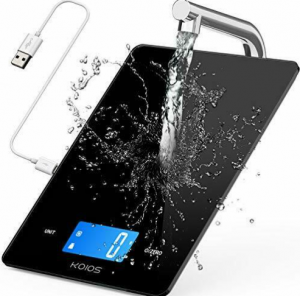 A kitchen scale is something you might already have in your kitchen cupboard, but if you don’t, this sucker is a multitasker — especially if you’re a baker like me.
What makes a good kitchen scale is its durability, its multi-unit functions, and its size. The KOIOS fits all my needs. I bought this way before I started to get into homemade coffee. I’ve mentioned that I love baking pies and desserts, so I already had this in my arsenal. The one I’m linking to is an updated version of the one I use.
This scale can switch between metric units (my preferred measurement system) and imperial. This is key because the following directions for pour over coffee are in the metric system.
But why would you want to limit yourself?
You might run into a pound cake recipe that uses imperial units.
This scale is also waterproof and USB rechargeable. I can’t tell you how frustrating it is when your kitchen scale’s batteries are dead because most take a watch-sized battery. I’m lucky if I can find 2 AAA batteries, let alone a watch battery.
You can buy the KOIOS Rechargeable Kitchen Scale on Amazon in 2 different colors with free shipping for Prime members.
Bodum Gooseneck Electric Kettle
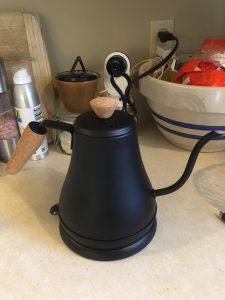 Can you tell I like the Bodum brand?
This is the second most expensive set up in my pour over coffee set up. I had no idea that electric kettles were so pricy.
But this one will be a multitasker in your kitchen for everything from pour over coffee to blooming a pot of French press grounds.
I just got this as a gift (directly off my Amazon wishlist) from B. I was using a beat up old stovetop tea kettle until about a week ago. I’ve had it since college. You should invest in a good electric kettle.
The Bodum kettle heats up in about 3 minutes, has a beautiful aesthetic, and is 100% stainless steel. The gooseneck spout makes it easy to measure out hot water as you’re pouring and even pour the water in a circular motion as your brewing the pour over coffee.
The cork handle keeps you from burning your hands. The heating coils turn off automatically once the water has reached a full boil. I also like that it’s fairly slim and fits into one of my cabinets (heating plate and all) easily.
You can buy the Bodum Gooseneck Electric Kettle on Amazon. The only drawback is that it doesn’t have a temperature gauge
Cuisinart Burr Grinder
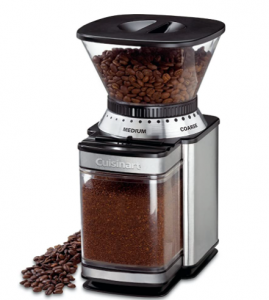 I’ve written and talked a lot about the importance of a good coffee burr grinder (or mill) and how they’re integral to the right grind of your beans. Pour over coffee has a unique grind that is called “pour over grind”. It’s finer than drip but coarser than espresso.
You’re only going to be able to achieve this in a uniform grind with a burr grinder. I have (and love) the Cuisinart one. It’s reliable, has a variety of grind settings, and won’t set you back a ton of money. I think I bought mine about 2 years ago for $60.00.
Burr grinders, especially the professional models, can get really expensive.
I promise once you start grinding your beans in this thing you’ll never use a blade grinder again. Not only does it give me the correct grind for pour over coffee, I can grind any bean for any brewing method.
Want Turkish coffee?
Your burr grinder has you covered.
Delving into cold brew coffee?
You need a burr grinder.
I could go on.
This is an investment piece, but you’ll have it for years and use it in just about any coffee brewing application you may run across. You can buy the Cuisinart Burr Grinder on Amazon with free shipping for Prime members.
Now that you know what kind of brew gear you need to make pour over coffee, let’s talk about how to make an actual cup. With a little practice and attention to detail, you’ll be slinging pour over to everyone in your house willing to drink it.
How to Make Pour Over Coffee for Beginners
Let’s talk about how to make pour over coffee.
This topic is wading into very opinionated water. People have argued extensively on the correct measurements and methods for this pour over coffee brewing. Coffee lovers are almost as opinionated as mommy bloggers.
You already know you need to use the pour over specific grind for your beans. Beans are important here. Lots of experts say to use single origin varietals to really bring out the nuances of the bean, but I like Stumptown’s Hair Bender Roast. Its sweetness and full-bodied flavors shine in a good cup of pour over method coffee. So this is what I’ll be using for this step by step guide to brewing pour over coffee.
Step 1 – Gather your gear and coffee. This should be an obvious step, but I find it’s easiest to brew this style coffee when I have all of things ready to go. Much like a good chef has their mis en place (French for everything in place), you’ll want to get out your grinder, scale, kettle, coffee and pour over maker. Things go much more smoothly if you’re not scrambling for smoothing.
I also suggest some good music to add to the fun of this coffee method. I love Shane Smith and the Saints.
Step 2 – Grind your coffee. Set your burr grinder to the correct setting for pour over coffee. I like to measure out a couple of days’ worth then store it in a dark jar. This step is so crucial to your final brew of coffee because this sets the literal tone for your coffee. You’re looking for a fine sand texture to your grind for pour over coffee.
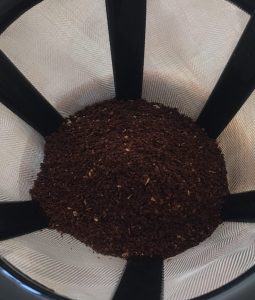 A pour over grind should look something like this. Any finer and you’re getting into espresso territory. Any coarser and you’re pushing a French press grind. We’re looking for the perfect cup of coffee. Let’s not bungle it up with the wrong grind. You may find, depending on the bean, that you like it slightly coarser or finer. Just make sure you stay close to a fine sand in your grind for pour over.
Step 3 – Get your hot water going in your kettle. You don’t need to finely measure out your water for this step. It’s just good to have your water going before you start measuring coffee. This step helps you not spend 20 minutes making a pot of coffee.
Step 4 – Measure coffee. I’ve found the best way to do this is to place your pour over coffee maker (including filter or basket with filter) on your scale. Make sure that it’s set to metric and NOT imperial. Once it’s on the scale, zero out the weight because you’re going to be adding your freshly ground beans directly to the filter.
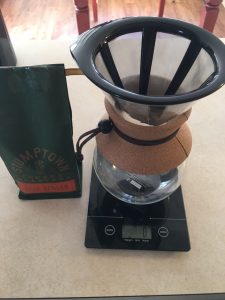 Then, when you have everything zeroed out on your scale set to metric it should look like this. Once you’re there simply measure out the correct ratio. This is where most people have opinions on how to make pour over coffee. I’m just sharing with you what works for me.
I stick to the standard of 17:1 ratio. So for my Bodum pour over I use 700 grams of water to 41 grams of coffee. If I’m not making a full pot (remember I’m the only coffee drinker in my home) I make a half pot (350 grams water to 21 grams coffee).
Simply place your correct ground coffee measurement in the filter. Zero out your scale again because you’re are ready to move on to the next step. Your water should be boiling at this point. Let’s move on.
Step 5 – Pour your water over the grounds. This is where this method of coffee gets its name. You’re going to remove your kettle from its heat source. Be careful. It’s hot. You’re going to be measuring 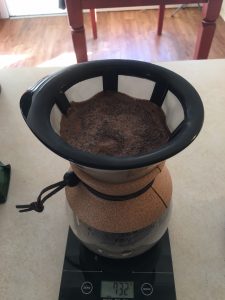 the correct ratio of water to coffee here again, so make sure your pour over maker is still on the scale and zeroed out. 700 grams water for 42 grams ground coffee (a full pot) and 350 grams water to 21 grams coffee (1/2 pot).
Slowly start pouring your hot water over the grounds in a circular motion making sure to saturate all the grounds. This style of coffee making is also known as a bloom brewing method. This gives your grounds an opportunity to bloom and release their flavors.
Make sure to cover any lighter spots (not enough saturation) and stir once your correct amount of water is added. This should take about 45 second to complete. Then you walk away.
Step 6 – Remove the filter and enjoy. After all the water has worked its way through your ground coffee, you’re going to have the perfect cup of coffee. I enjoy it black with just a splash of vanilla almond milk, but it really does stand up on its own.
Conclusion
This concludes my post about pour over coffee for beginners. I hope I’ve explained what it is and how it works well enough that you can brew your own perfect cup of coffee.